Agencies rarely lose clients over a single bad month. They lose them when results are hard to see, reports arrive late, invoices cause friction, or weeks pass with no contact. The tools below are for small and mid-size marketing agencies and freelancers, and each was chosen for how directly it fixes one of those causes: reporting, communication, feedback, billing, or relationship tracking. Pricing and plan details change often, so check each vendor's site; anything below is accurate to the vendors' public descriptions as of October 2026.
Quick Comparison of the Nine Tools
- ClientPlug: best for Meta and Google Ads agencies and freelancers; pricing on its website; shows payment status and ad performance health per client in one dashboard.
- AgencyAnalytics: best for multi-channel agencies; pricing on its website, scaled per client campaign; an always-on branded client login covering SEO, PPC, social, and email.
- DashThis: best for agencies wanting simple recurring reports; pricing on its website, per dashboard; fast template-based setup with predictable costs.
- HubSpot CRM: best for structured renewal and check-in processes; free tier available; a free CRM that can grow into a full service and marketing platform.
- ChurnZero: best for larger agencies with retainer portfolios; quote-based; formal account health scoring with automated at-risk playbooks.
- Typeform: best for regular NPS and quarterly feedback; pricing on its website; form design that lifts response rates on client check-ins.
- Slack Connect: best for engaged clients who want fast communication; included with paid Slack plans; shared cross-organization channels that replace email threads.
- Loom: best for personal explanations of results; free tier available; turns static reports into short video walkthroughs.
- Dubsado: best for freelancers and boutique agencies standardizing admin; pricing on its website; automated onboarding workflows with a branded client portal.
1. ClientPlug
ClientPlug is the all-in-one client organizer for digital marketing agencies and freelancers, and it is our own product, so weigh this entry with that in mind. It pulls payment tracking, ad performance, and reporting into one dashboard, which addresses two churn causes at once: clients who cannot see results and clients whose billing goes sideways.
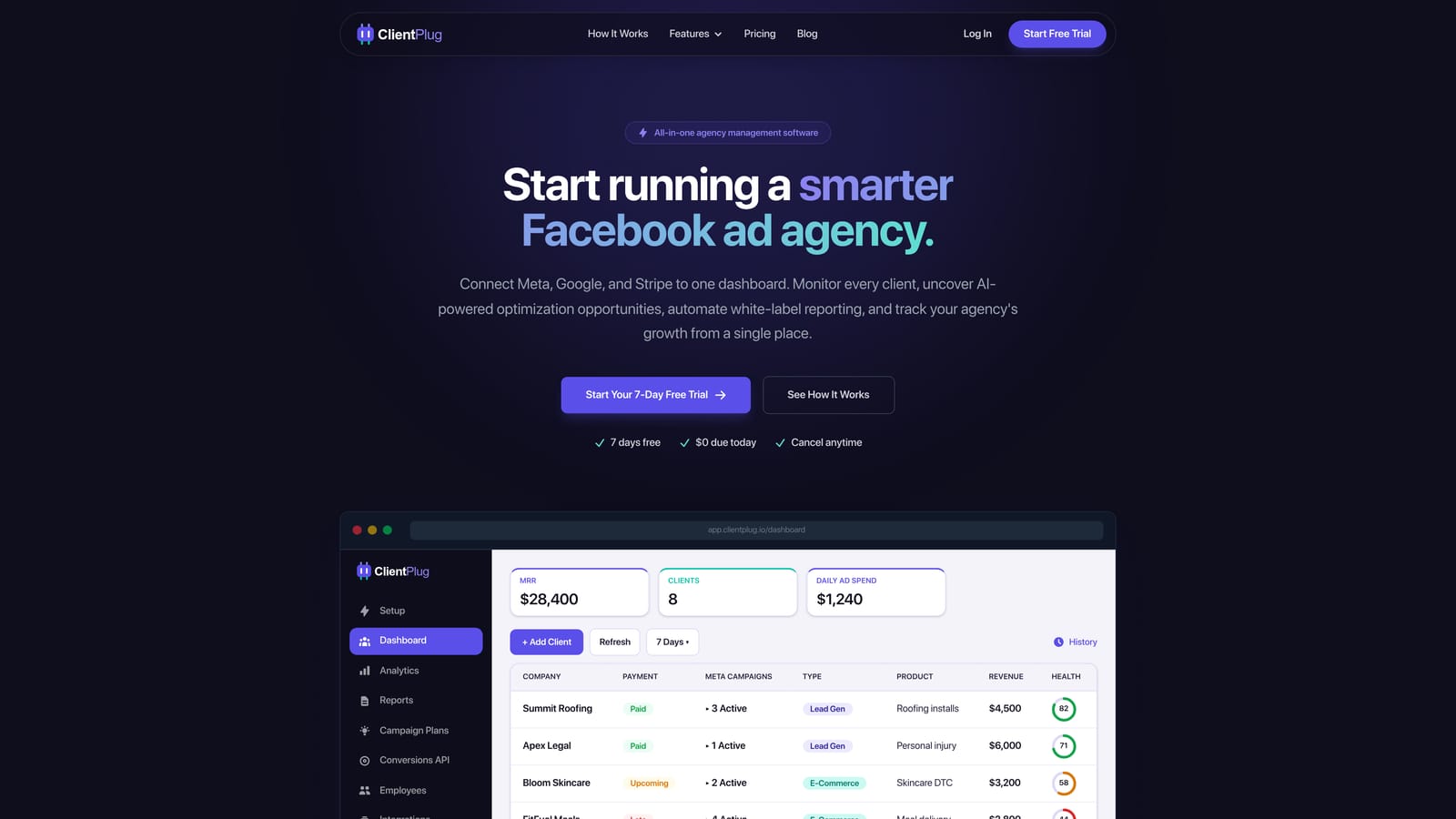
What sets it apart on this list is that it puts payment status and ad performance health side by side for each client. You can see at a glance that a client is two weeks late on an invoice while their cost per lead has doubled, which is exactly the combination that tends to precede a cancellation. Most other tools here cover only one side.
- Client payment tracking shows who has paid, who is late, and what is outstanding without digging through invoices.
- Meta and Google Ads monitoring surfaces the health of individual ads, campaigns, clients, and your agency as a whole.
- Automated white-label reports go to clients under your branding, so proof of results arrives on schedule.
- AI campaign optimization suggests where performance can improve, helping you act before a client complains.
- Conversion API setup takes a few clicks, improving the tracking data your reports rely on.
It connects to Meta Ads and Google Ads and syncs payments, campaigns, and client data automatically, so day-to-day running usually falls to the agency owner or a media buyer rather than a dedicated admin. The limits are real: it is built for paid media agencies, not SEO, social, or email shops, and it is not a full CRM or project management tool. If you need deal pipelines, contracts, or task boards, you will pair it with something else. Pricing is listed on its website; check there for current plans.
Best for: Meta and Google Ads agencies and freelancers who want billing and performance in one place.
2. AgencyAnalytics
AgencyAnalytics is a reporting platform that gives each client a white-label dashboard covering SEO, PPC, social, and email. It is designed for agencies that sell several channels and want clients to see everything under one branded roof.
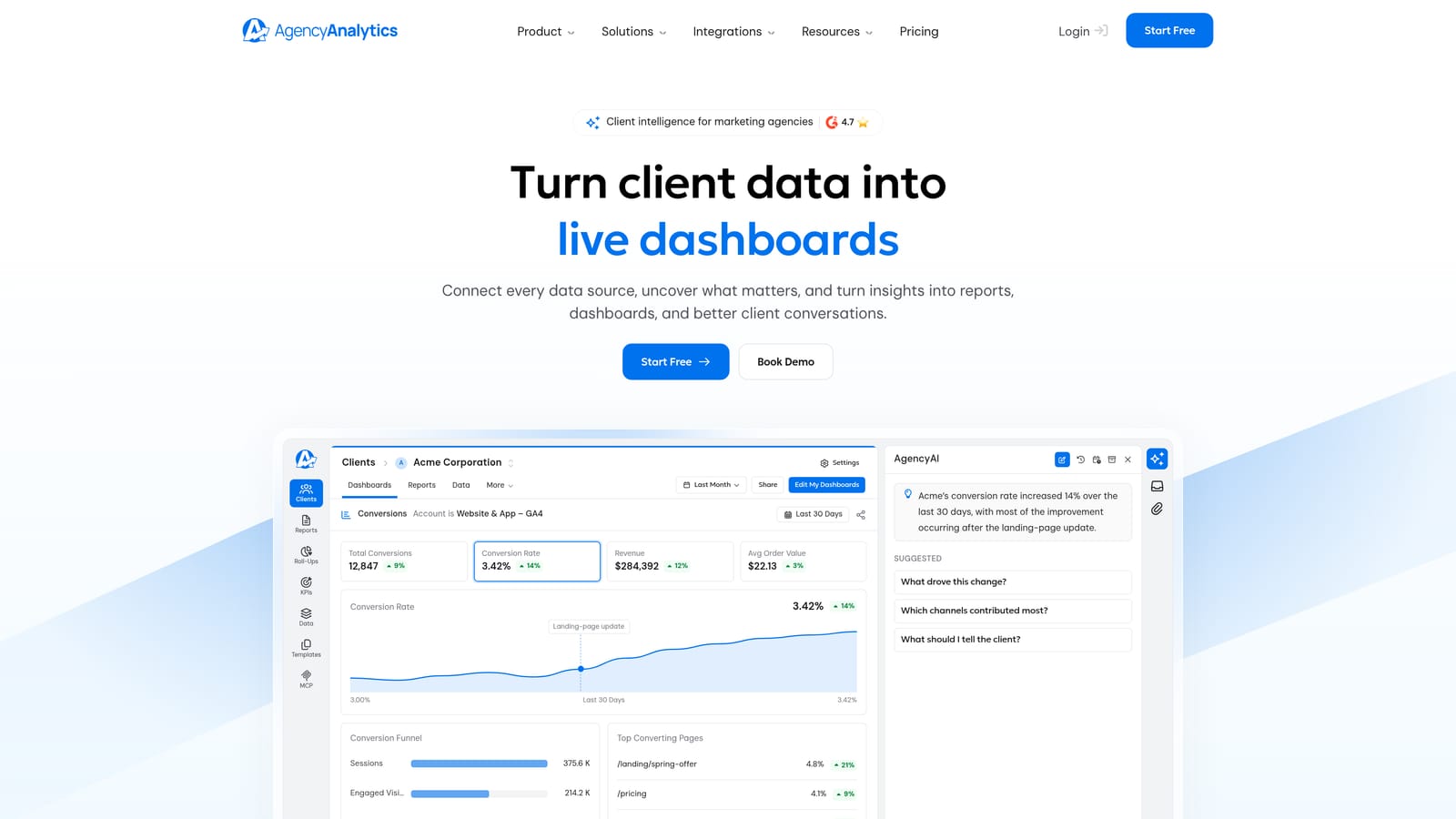
Its distinctive strength is breadth plus the client login. Rather than waiting for a monthly PDF, clients can check their numbers whenever they like, which removes the "what are you actually doing for me?" doubt that drives silent churn.
What you get
- White-label dashboards carry your branding, so the tool reinforces your agency rather than the vendor.
- A large library of marketing integrations pulls channels together without manual exports.
- Scheduled reports go out automatically on the cadence you set.
- Rank tracking gives SEO clients visible movement to point to.
- The client login portal lets stakeholders self-serve between calls.
Setup, limits, and cost
It connects to Google Analytics, Google Ads, Meta Ads, Search Console, and many other sources. Setup means connecting accounts and building or cloning dashboard templates, typically handled by an account manager or analyst. It has no billing or relationship tracking, so it will not tell you a client is behind on payments or overdue for a call. It also does not interpret results for you; a dashboard without commentary can leave clients confused. Pricing is per client campaign, so costs rise as your roster grows. See its website for current plans.
Best for: Multi-channel agencies needing branded dashboards clients can check anytime.
3. DashThis
DashThis turns marketing data into templated dashboards and scheduled reports. It is aimed at agencies that want consistent, good-looking recurring reports without a long build process.
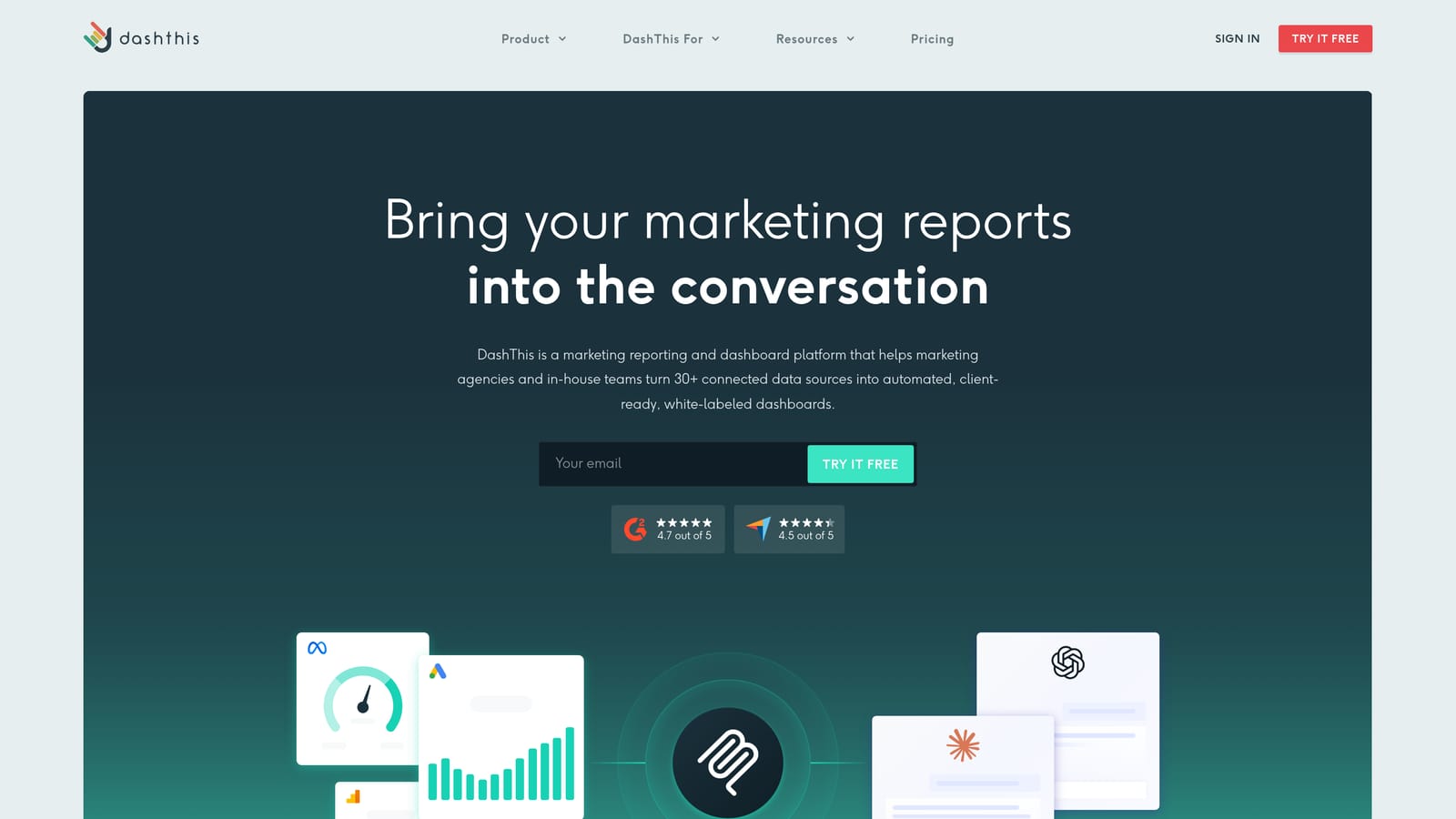
Where it stands out is speed and cost predictability. Plans are based on the number of dashboards rather than on every connected campaign or seat, so you can forecast spend as you add clients. For a small agency, that clarity matters.
- Report templates let you stand up a client report in a short session instead of designing from scratch.
- Scheduled delivery sends PDFs or live links automatically, so reports never depend on someone remembering.
- Many data source connections cover the usual ad, analytics, and email platforms.
- Custom branding keeps the report looking like yours.
- Preset widgets cover common metrics so you are not building each chart by hand.
It integrates with Google Analytics, Google Ads, Facebook Ads, Mailchimp, and others. Setup is light, and one marketer can run the whole thing. The tradeoff is depth: custom analysis options are limited, so if you want to slice data in unusual ways you may feel boxed in. It has no communication, billing, or client-tracking features, and it will not flag a struggling account. Pricing is per-dashboard on tiered plans; see its website for current figures.
Best for: Agencies wanting simple, recurring reports with minimal setup.
4. HubSpot CRM
HubSpot CRM records every contact, conversation, and deal in one place, with tickets and automated follow-up sequences layered on top. For retention, its value is process: nothing about a client relationship lives only in one person's head.
Its edge over the rest of this list is that the CRM is free to start and can grow into service and marketing products as the agency does. Few tools here let you begin at no cost and expand later without migrating data.
- Contact and interaction history shows when you last spoke to a client and what was said.
- Deal pipelines can track renewals and upsells the same way you track new business.
- Ticketing keeps client requests from getting lost in inboxes.
- Email sequences and tasks prompt regular check-ins so quiet clients do not drift.
- Reporting dashboards show which accounts are overdue for contact or up for renewal.
It integrates with Slack, Gmail, Outlook, and Zapier, among others. Setup takes more effort than the reporting tools: you need to design your pipeline stages, properties, and sequences, and someone must own that system. Costs climb noticeably at higher tiers, and the platform can feel heavy for a two-person shop. It also holds no ad performance data, so it tracks relationships rather than results. A free tier exists, with paid plans priced by tier and seats; see its website for current details.
Best for: Agencies building structured renewal and check-in processes around relationships.
5. ChurnZero
ChurnZero is a customer success platform that scores account health and triggers playbooks when an account looks at risk. Account health here means a composite signal, such as usage, engagement, and renewal timing, that predicts whether a customer will stay.

It does this more formally than anything else on the list. You define what a healthy account looks like, and the platform automatically prompts the right person to act when a score drops, rather than relying on someone noticing.
- Health scoring turns scattered signals into a single, comparable number per account.
- Automated playbooks assign tasks and outreach when scores fall or renewals approach.
- Renewal tracking keeps retainer end dates visible well ahead of time.
- Customer journey views show where each account sits in its lifecycle.
- Engagement analytics reveal which clients are active and which have gone quiet.
It integrates with Salesforce, HubSpot, and Slack. Implementation is a real project, and it needs a person or team who owns customer success. The honest limitation is fit: it was built for subscription software companies, where product usage data feeds the scores. Agencies do not have that data in the same form, so you would be inventing your own health inputs, and for a small agency the whole thing is overkill. Pricing is quote-based.
Best for: Larger agencies with retainer portfolios and dedicated account teams.
6. Typeform
Typeform builds conversational forms and surveys, which agencies use for client feedback, NPS, and onboarding questionnaires. NPS, or Net Promoter Score, asks how likely a client is to recommend you on a 0 to 10 scale and gives you a simple trend to watch.
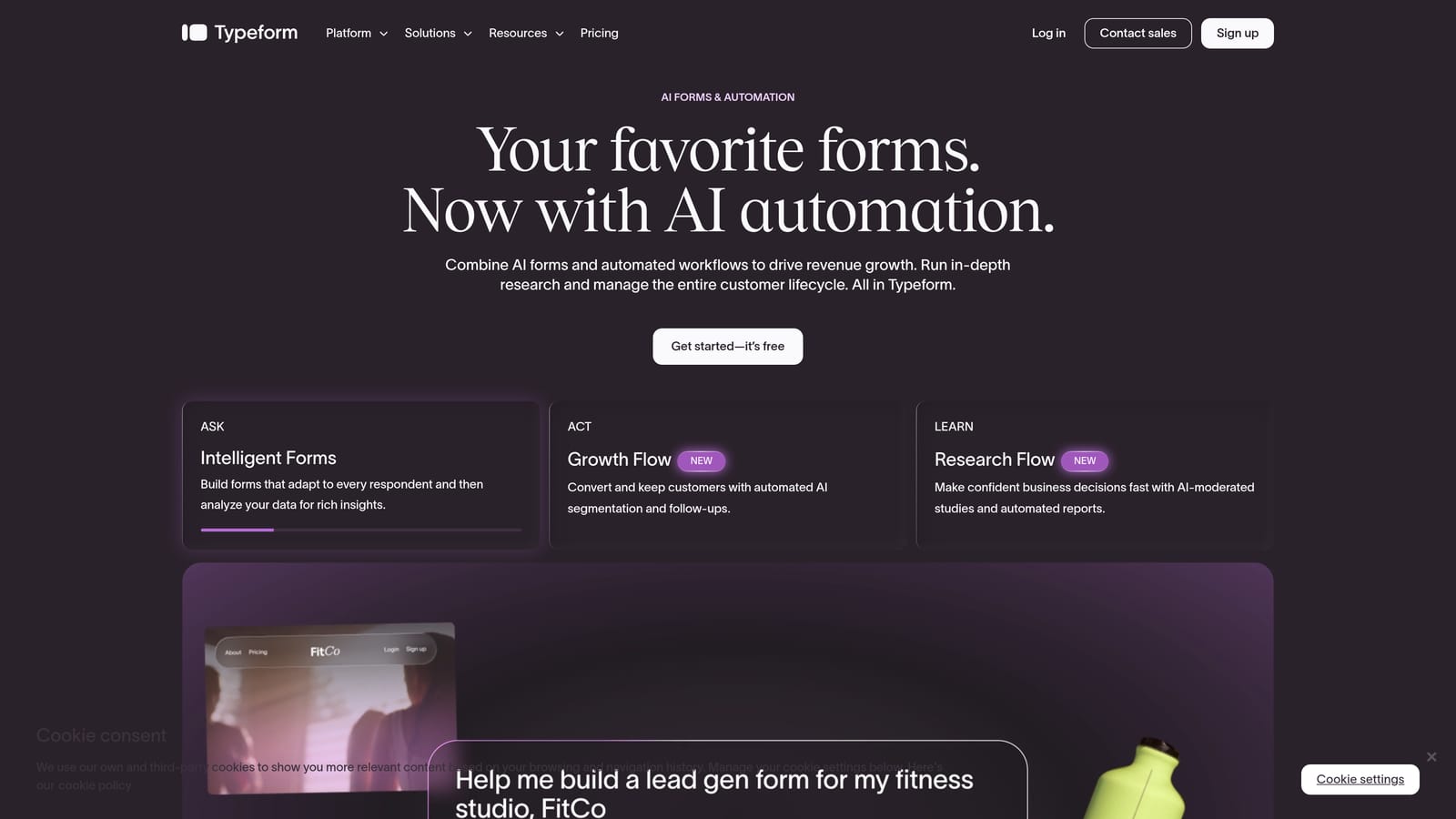
Its distinguishing quality is design. One question at a time, with a clean branded look, tends to get more clients to finish a check-in than a long, dull survey would, and a feedback tool nobody answers is worthless.
- Conversational forms keep check-ins short and easy to complete.
- Logic branching asks follow-ups only when a low score or a specific answer warrants it.
- NPS and survey templates get you started without designing from scratch.
- Branded themes match your agency's look.
- Response analytics summarize scores and comments over time.
It connects to Slack, HubSpot, Zapier, and Google Sheets, so a low score can post to a channel or create a CRM task. That wiring is what makes it useful, and it takes a little setup. By itself Typeform only collects answers: it does not monitor account health or act on responses, so someone must read the results and follow up. Plans are tiered monthly, with limits on responses and features; see its website.
Best for: Agencies running regular NPS and quarterly feedback check-ins.
7. Slack Connect
Slack Connect lets your agency and a client's organization share Slack channels, so conversation happens in one searchable thread rather than scattered across email. It suits agencies whose clients already live in Slack.
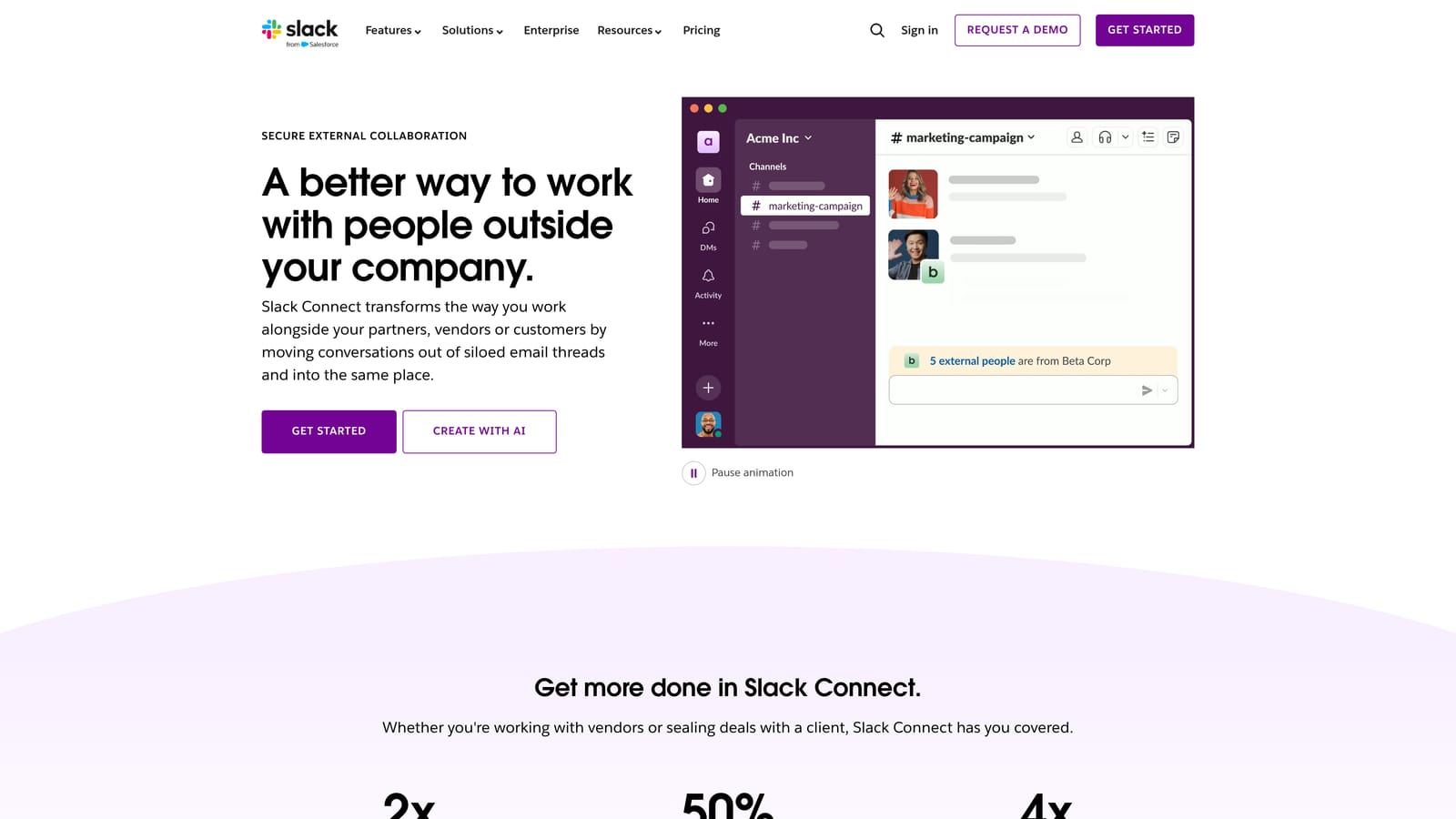
Its unique contribution is responsiveness. Questions that would sit in an inbox for a day get answered in minutes, and clients see that you are present, which counters the sense of silence between calls.
- Shared external channels put both teams in the same conversation.
- Searchable history means nobody has to hunt for what was agreed last month.
- File sharing keeps creative and reports alongside the discussion.
- Notifications and reminders keep requests from being forgotten.
- App integrations bring in tools such as Google Drive, Asana, HubSpot, and Zapier.
Setup is easy if you already use Slack: you send an invite and the client accepts. The catch is that both parties need Slack, and many smaller clients do not use it. It can also create always-on expectations, with clients assuming instant replies at any hour, so set response-time norms early. It stores no performance or billing data. It is included with paid Slack plans, so cost follows your Slack seat count; see its website for current pricing.
Best for: Agencies with engaged clients who want fast, ongoing communication.
8. Loom
Loom records your screen and camera and gives you a share link instantly. Agencies use it to walk clients through a report or explain a result personally without scheduling another call.
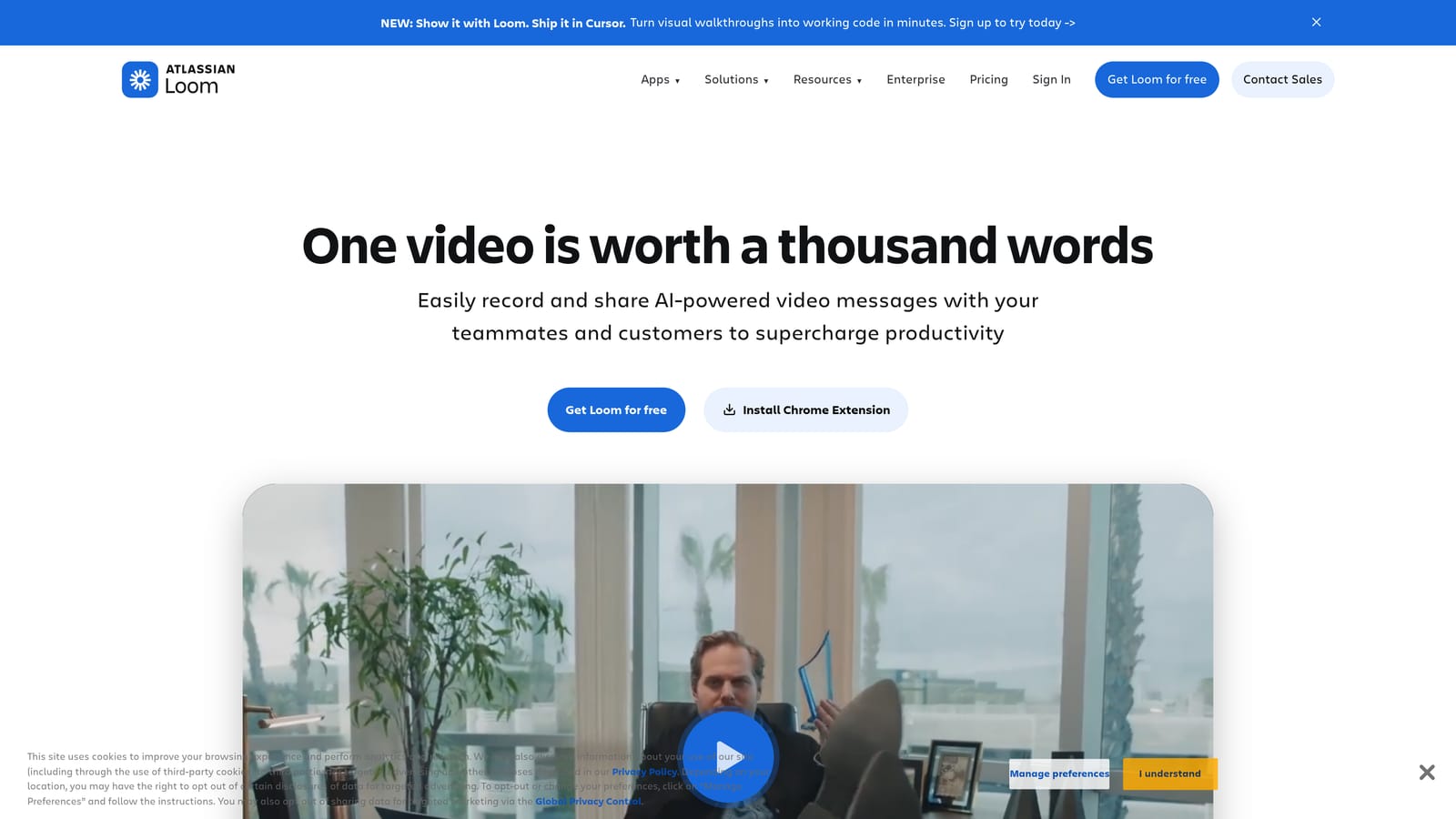
That addresses a common misconception: a report alone does not retain a client, because numbers need interpretation. A three-minute video saying "here is what moved, why, and what we do next" does the interpreting, and it feels personal in a way a PDF cannot.
- Screen and camera recording lets you show the dashboard while you talk through it.
- Instant share links remove upload and export steps.
- Viewer insights show whether the client actually watched.
- Comments and reactions give clients an easy way to reply.
- Transcripts make videos skimmable and searchable.
It integrates with Slack, Gmail, Notion, and Jira, and anyone on the team can use it with no real setup. Its limits are plain: it manages no data, tracks no accounts, and automates no follow-up, so it complements a reporting tool rather than replacing one. Recording also takes time per client, which becomes a burden at large volumes. A free tier exists, with paid plans above it; see its website for limits.
Best for: Agencies and freelancers who want to explain results personally without extra meetings.
9. Dubsado
Dubsado is a client management platform for service businesses, covering contracts, invoices, scheduling, and workflows. It targets the front and back end of the relationship: how smoothly a client gets onboarded and billed.
Its best trick is automated onboarding. A signed proposal can trigger the contract, the first invoice, a questionnaire, and a booking link, all behind a branded client portal, so new clients get a polished first impression with little manual effort.
- Contracts and proposals let clients sign digitally within the same system.
- Invoicing and payment plans reduce billing friction for clients who prefer to spread costs.
- Automated workflows send the right message or task at each stage.
- The scheduler removes back-and-forth on call times.
- The client portal gives each client one place for documents and payments.
It integrates with Stripe, PayPal, Zapier, and Google Calendar. Expect a real setup session to build templates and workflows, and some people find the interface fiddly at first. Once built, one owner can run it. Dubsado has no ad platform or performance data, so it cannot show results, and it was designed more for solo service providers than for agencies with large teams. It uses monthly or annual plans; see its website for current pricing.
Best for: Freelancers and boutique agencies standardizing onboarding and admin.
Building a Lean Retention Stack From These Nine
Retention is not one person's job, and adding more tools does not add more retention. Two or three well-used tools beat nine half-configured ones. Match the stack to the churn cause you see most often:
- Paid media agencies: start with ClientPlug for payments, performance, and white-label reports, and add Loom to explain the numbers.
- Multi-channel reporting: AgencyAnalytics for breadth, or DashThis if you want simpler, cheaper recurring reports.
- CRM-led relationships: HubSpot CRM for check-in cadence and renewal tracking. Consider ChurnZero only with a dedicated account team.
- Feedback collection: Typeform, wired into Slack or your CRM so low scores prompt action.
- Communication: Slack Connect for clients already on Slack.
- Freelancer admin: Dubsado for onboarding, contracts, and invoicing.
A sensible lean combination for a Meta and Google Ads shop is ClientPlug plus Loom, with HubSpot added once you have enough clients to need a formal renewal process. If you want to see how one dashboard can cover payments, performance, and reporting for your clients, Learn more about our services.